True crime news logo
  • News

Sign up for our newsletter and get the latest stories

Never miss the latest true crime news, reviews and top lists — plus new podcasts, series, films and books.

You can unsubscribe with one click from any email.

True crime news logo

The international true crime destination. Cases, documentaries, podcasts and travel routes.

© 2026 truecrime.news. All rights reserved.

The Insider: whistleblower drama exposes abuse of power

The Insider: How Hollywood Dramatized Big Tobacco's Reckoning

Michael Mann's 1999 film brought Jeffrey Wigand's whistleblowing crusade to the screen—and ignited a legal firestorm

Published
November 6, 2025 at 12:00 PM

In 1999, director Michael Mann released The Insider, a film depicting biochemist Jeffrey Wigand's exposure of Brown & Williamson's manipulation of tobacco products. Based on true events that unfolded in the mid-1990s, the film dramatized one of corporate America's most consequential whistleblowing cases.

Jeffrey Wigand, born December 17, 1942, served as vice president of research and development at Brown & Williamson from January 1989 until his firing on March 24, 1993. During his tenure, Wigand discovered practices that would reshape the tobacco industry: the company deliberately manipulated its tobacco blend with chemicals like ammonia to increase the addictive effect of nicotine, while knowingly adding carcinogenic and addictive substances such as coumarin to its products.

After his dismissal, Wigand became determined to expose these practices. He was eventually persuaded by Lowell Bergman, a producer at CBS's *60 Minutes*, to go public with his allegations. On February 4, 1996, Mike Wallace conducted a landmark television interview with Wigand, broadcasting his revelations to millions of viewers. The interview proved pivotal—not only for public awareness, but also as evidence in litigation. Wigand was later subpoenaed in connection with Mississippi's lawsuit against the tobacco industry, the first state suit seeking to recover smoker health care costs.

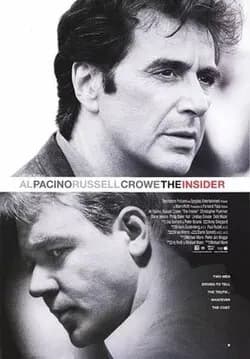
Michael Mann's film adaptation, co-scripted by Mann and Eric Roth and released by Disney's Touchstone Pictures, starred Russell Crowe as Wigand and Al Pacino as Bergman. The movie chronicles Wigand's journey from corporate insider to whistleblower, capturing the legal and personal threats he faced as he worked with *60 Minutes* to bring the story to air despite mounting pressure from Brown & Williamson's legal team.

The film's depiction of Wigand's ordeal was grounded in reality. After his initial firing, Wigand faced systematic harassment and anonymous death threats. Brown & Williamson, seeking to discredit him, hired investigator Terry Lenzner of Investigative Group International to compile a 500-page dossier against him. According to media reporting, the findings were either unsubstantiated or trivial—a tactic that ultimately failed to diminish Wigand's credibility.

Brown & Williamson's legal strategy extended to the film itself. The company accused Disney of distorting facts and threatened legal action. The tobacco firm commissioned a survey of moviegoers alleging the film caused financial harm and prejudiced public opinion against the industry. These complaints, however, did not prevent the film's distribution or impact.

The stakes for the tobacco industry were enormous. On June 20, 1997, just as The Insider was entering production, 40 state attorneys general reached a landmark $368 billion settlement with the tobacco industry. As a condition of the settlement, Brown & Williamson agreed to drop its pending lawsuit against Wigand—a decision the Attorneys General effectively forced by threatening to derail the agreement. In exchange, the industry gained FDA jurisdiction over tobacco products but surrendered certain marketing and advertising rights.

Wigand's whistleblowing, documented first by *60 Minutes* and later immortalized by Mann's film, became emblematic of the power of individual conscience against institutional malfeasance. The Insider brought his story to international audiences, ensuring that the mechanisms of tobacco industry deception—ammonia manipulation, additive concealment, knowledge suppression—would remain part of the public record and cultural memory.

The film's release in 1999 solidified Wigand's legacy not as a disgruntled former employee, but as a principled whistleblower whose actions contributed to sweeping regulatory and legal reforms in the tobacco industry.

**Sources** - https://en.wikipedia.org/wiki/Jeffrey_Wigand - https://pmc.ncbi.nlm.nih.gov/articles/PMC1117230/ - https://www.whistleblowers.org/whistleblowers/jeffrey-wigand/ - https://www.youtube.com/watch?v=yylCmRwvXLA

Read more

The Crime: A Danish Thriller Setting the Standard
TV Series

Forbrydelsen: The Danish Crime Drama That Defined Nordic Noir

Bad Batch unveils medical scandal behind stem cells
Podcast

The Wild West of Stem Cells: How One Company Harmed Patients

Police in Decline Digs into Danish Blunders
TV Series

Danish Police Under Fire in New Documentary Series

Related Content
The Crime: A Danish Thriller Setting the Standard

Forbrydelsen: The Danish Crime Drama That Defined Nordic Noir

Bad Batch unveils medical scandal behind stem cells

The Wild West of Stem Cells: How One Company Harmed Patients

Police in Decline Digs into Danish Blunders

Danish Police Under Fire in New Documentary Series

A figure resembling Martha Stewart walks briskly through a bustling outdoor market, surrounded by vibrant flowers and fresh produce, representing her post-prison comeback and revival in the lifestyle industry.

Martha Stewart: From Federal Prison to Business Empire

Advertisement
SS

Susanne Sperling

View all stories →
Share this post: