Newport 1979: Sunny Found Lifeless, Claus Accused
On a cold December morning in 1979, housemaid Maria Schrallhammer found her employer, heiress Martha "Sunny" von Bülow, lifeless on the marble floor of the bathroom at Clarendon Court, the family's grand mansion in Newport, Rhode Island. This discovery marked the beginning of one of the most notorious and heavily publicized criminal cases of the century in the United States—a case involving unfathomable wealth, accusations of infidelity, and a complex medical mystery. At the center of this high-profile case stood Sunny's husband, Danish-born Claus von Bülow, who soon faced accusations of attempted murder on two counts. The dramatic story of the glittering facade of the wealthy upper class, hidden family conflicts, and sudden tragedy captivated the public both in the United States and internationally.
Behind the Facade: Their Marriage of Wealth and Tensions
Martha "Sunny" Crawford, born in 1932 into an extremely wealthy family, met the charming Claus von Bülow, originally from Copenhagen, Denmark, in 1966, shortly after her divorce. They married the same year and quickly became part of the international jet set, with prominent addresses on Fifth Avenue in New York and the impressive Clarendon Court in Newport. Behind the glamorous facade of wealth and social status, however, lay serious problems. There were financial tensions, as Claus von Bülow allegedly felt economically dependent on his wife's fortune, and Sunny's personal struggles with alcoholism and depression placed considerable strain on their marriage.
Two Comas 1979-80: Children's Suspicions and Insulin Discovery
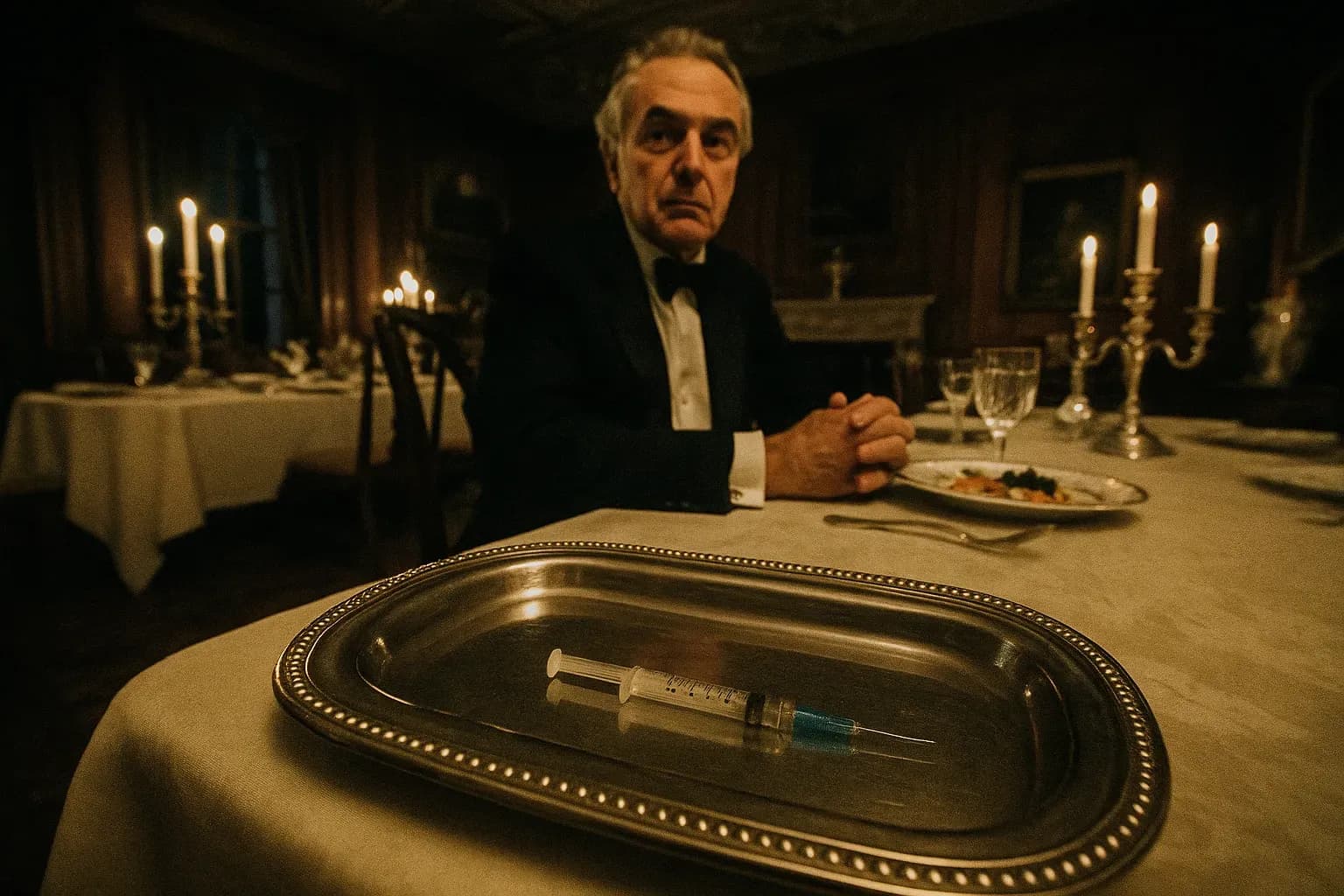
The first dramatic incident occurred at Christmas 1979 when Sunny von Bülow collapsed after a family dinner. Attending physicians determined that the collapse was caused by low blood sugar and strongly warned her against consuming sugar. But just one year later, on Christmas Eve 1980, Sunny fell into a coma again—this time a permanent coma from which she would never awaken. Sunny's adult children from her first marriage, Alexander von Auersperg and Ala von Auersperg, quickly grew suspicious of their stepfather. Why had Claus von Bülow delayed calling a doctor? And what was contained in the locked cabinet drawer in his dressing room, which they accessed and examined through private detectives? The discovery was shocking: a syringe with insulin-colored residue and a bottle of insulin.
Rhode Island 1982: Testimony, Insulin Evidence, and Conviction
Charges against Claus von Bülow for two counts of attempted murder by insulin injection were formally filed in 1981. The subsequent trial in Rhode Island in 1982 became a true media circus, with the couple's most intimate details exposed to the public. Housemaid Maria Schrallhammer testified to Claus von Bülow's apparent indifference during Sunny's crisis, and Claus's then-mistress, Alexandra Isles, gave an emotional testimony about her pressure on him to leave his wife. What appeared to be the decisive technical evidence was the discovery of insulin on the syringe in Claus von Bülow's cabinet. After six weeks of intense deliberation, the verdict came: Guilty, with a sentence of 30 years in prison for attempted murder.
The Appeal: Dershowitz's Defense and Overturning in 1984
Claus von Bülow's new, star-studded legal team, led by renowned Harvard professor and defense attorney Alan Dershowitz, launched an effective appeal that completely altered the case's evidence. They argued convincingly that the original insulin samples had been contaminated during storage, and that Sunny von Bülow's repeated comas could have resulted from self-inflicted overdoses of sugar and alcohol—a theory supported by eight prominent medical experts, including Dr. Vincent Marks. He demonstrated that insulin injected into the body would leave specific chemical traces, which were absent in Sunny's case. In 1984, Rhode Island's Supreme Court overturned the original conviction, primarily citing improper collection and handling of evidence.
Acquittal 1985: New Strategy and Dr. Dal Cortivo's Evidence
The retrial took place in 1985 and became a masterclass in legal defense strategy, now led by attorneys Thomas Puccio and John Sheehan. The defense's focus was squarely on casting scientific doubt on the prosecution's evidence and highlighting the lack of definitive proof that Claus von Bülow had actively administered insulin to his wife. A key moment in this second trial came when forensic pathologist Dr. Leo Dal Cortivo demonstrated to the jury that an injected syringe would not retain visible insulin residue on the outside, as was the case with the discovered syringe. After only four days of deliberation, the jury acquitted Claus von Bülow of both counts of attempted murder.
Aftermath: Sunny's Death, Claus in London, and Family Tragedy
Sunny von Bülow never awoke from her coma. She spent the next 28 years in a vegetative state, cared for at considerable annual expense from her fortune, until her death in 2008. Claus von Bülow, born in Denmark with roots in Copenhagen, lived after his acquittal a relatively public life as a social icon in London, where he died in 2019 at age 92, never having admitted guilt. The von Bülow family remained deeply divided; Sunny's children, Alexander and Ala, steadfastly maintained their conviction of Claus's guilt, while his and Sunny's daughter together, Cosima von Bülow, consistently stood by her father's side. The complex case was further cemented in popular culture with the Oscar-winning Hollywood film *Reversal of Fortune* from 1990, which depicted the trial proceedings.
The Von Bülow Case: Sunny's Coma and Wealth's Role in Justice
The controversial case of Claus and Sunny von Bülow, often simply known as the Claus von Bülow case, still leaves many unanswered questions and continues to raise ethical debates. If insulin was not the cause, what then caused Sunny von Bülow's permanent coma? New theories have pointed to possible self-harm, an accident, or rare metabolic diseases, which keeps the case as an ongoing medical mystery. The discussion about wealth's influence on the justice system—both the prosecution's original resources and the defense's later ability to hire expensive experts—is also a persistent legacy of the case. But perhaps the case's most central legacy is its ruthless exposure of how money, social status, and powerful networks can shape the course of justice. Behind the legal technicalities and medical reports lies a deeply human tragedy: a woman whose life ended as the focal point of a bitter legal dispute; children split in their loyalty; and a man whose name will forever be associated with suspicion, regardless of the legal acquittal, which for many leaves a sense of an unsolved case. It was a Shakespearean tragedy that unfolded in American courtrooms and captured the attention of the entire world.
Sources:
wgbh.org information.dk latimes.com upi.com time.com
Interested in complex legal cases and mysteries from the upper class? Follow CrimiNews for more in-depth analyses of reality's darkest chapters.