True crime news logo
  • News

Sign up for our newsletter and get the latest stories

Never miss the latest true crime news, reviews and top lists — plus new podcasts, series, films and books.

You can unsubscribe with one click from any email.

True crime news logo

The international true crime destination. Cases, documentaries, podcasts and travel routes.

© 2026 truecrime.news. All rights reserved.

Sagsmappe

Timothy McVeigh: America's Deadliest Domestic Terror Attack

How a former soldier killed 168 people in Oklahoma City and became the first federal execution in nearly four decades

Mappe Åbnet: JUNE 6, 2025 AT 09:59 AM
A figure resembling Timothy McVeigh in handcuffs, escorted by federal agents, near a smoldering Murrah Building in Oklahoma City, debris still scattered on the ground
BEVIS

Sagsdetaljer

Quick Facts

Klassifikation:

Terror
Assassination
Mass death
Trial
Oklahoma
USA
Colorado

Quick Facts

LocationAlfred P. Murrah Federal Building, Oklahoma City, Oklahoma, USA

On the morning of April 19, 1995, at 9:02 a.m., Timothy James McVeigh parked a rented Ryder truck in the handicap zone outside the Alfred P. Murrah Federal Building in Oklahoma City. Inside was approximately 5,000 pounds of ammonium nitrate and nitromethane—an improvised explosive device that would level one-third of the building and reshape American understanding of domestic terrorism.

When the bomb detonated, it killed 168 people, including 19 children. Another 684 were injured. More than 300 buildings in the surrounding area sustained damage. The attack would remain the deadliest act of domestic terrorism in U.S. history until September 11, 2001.

McVeigh, born April 23, 1968, was a former U.S. Army soldier with ties to the extreme right-wing Patriot movement. According to prosecutors, he had assembled the bomb at Geary Lake State Park in Kansas alongside Terry Nichols, an accomplice who would later be convicted of conspiracy and involuntary manslaughter. A third figure, Michael Fortier, had advance knowledge of the plot but was convicted only for failing to inform authorities.

The motive was rooted in rage. McVeigh was avenging the deaths of more than 70 people killed during the Waco siege exactly two years earlier, on April 19, 1993. His ideology was shaped partly by *The Turner Diaries*, a white supremacist novel that served as a blueprint for anti-government violence.

McVeigh's capture came swiftly. Within hours of the bombing, he was pulled over on Interstate 35 for having no license plate. Already in Noble County jail on unrelated charges—carrying a concealed handgun and lacking vehicle registration—he was linked to the bombing as a 2,000-member federal investigation team quickly pivoted from initial suspicions of Middle Eastern involvement.

Indiana
Revenge
Fbi
Violence
Military
Radicalization
Death penalty
High-profile case
mordssag
domstol
justitsmordet
hvidvaskning
magtmisbrug
justitssvigt
Sagsstatus
Løst
Sted
Alfred P. Murrah Federal Building, Oklahoma City, Oklahoma, USA

Before his arraignment, McVeigh admitted to his attorneys: "Yes, I did the bombing." He later recanted publicly but eventually owned the attack, quoting *A Few Good Men*: "You can't handle the truth! Because the truth is, I blew up the Murrah Building."

The trial began in 1997. A federal jury convicted McVeigh on 11 counts: murder, conspiracy, and use of a weapon of mass destruction. Eleven days later, he was sentenced to death—a verdict that would make him the focal point of a national debate about capital punishment that intensified as his execution date approached.

On June 11, 2001, McVeigh was executed by lethal injection at the federal penitentiary in Terre Haute, Indiana. He was the first person executed under federal law since 1963, marking a watershed moment for capital punishment in the United States. His execution drew international attention and reignited discussions about the death penalty's moral and practical dimensions.

The rescue and recovery operation was staggering in scope. More than 12,000 volunteers and rescue workers participated in the effort to save survivors and recover remains. The human cost extended far beyond the immediate death toll: families devastated, communities fractured, and a nation confronted with the reality that terrorism could originate from within.

Evidence suggests McVeigh may not have acted entirely alone. Witnesses reported seeing two trucks at Geary Lake during bomb assembly, and investigators documented links to white supremacist figures like Richard Guthrie. However, no additional prosecutions followed, leaving unanswered questions that persist in the historical record.

The Oklahoma City bombing remains a watershed moment in American crime history—the deadliest domestic terror attack until 9/11, and a case that defined how the U.S. justice system addresses acts of ideological violence.

**Sources**

https://en.wikipedia.org/wiki/Timothy_McVeigh

https://irlaw.umkc.edu/popular_media/44/

https://famous-trials.com/oklacity/730-home

https://www.biography.com/crime/timothy-mcveigh

https://www.britannica.com/event/Oklahoma-City-bombing

Read more

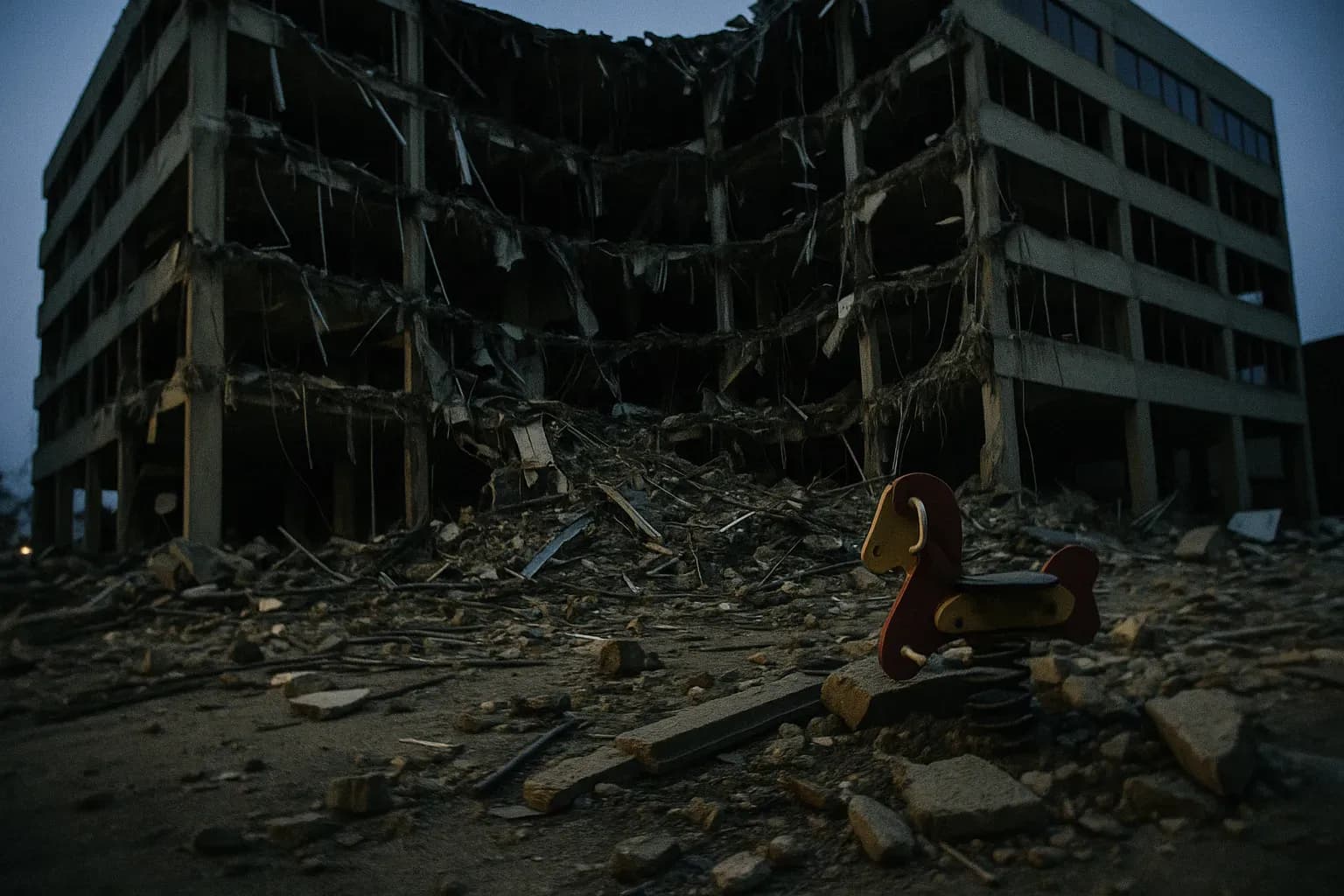
A demolished office building facade in Oklahoma City, debris scattered across the ground, with a children's playground toy partially buried in the rubble.
Case

Oklahoma City Bombing 1995: McVeigh's Deadly Revenge

American Murder shocks: Technology exposes constant violence
YouTube

How Social Media Algorithms Weaponize True Crime Content

Generation Kill exposes the brutality of war
TV Series

Generation Kill: Inside HBO's $56M War Miniseries

Related Content
A demolished office building facade in Oklahoma City, debris scattered across the ground, with a children's playground toy partially buried in the rubble.

Oklahoma City Bombing 1995: McVeigh's Deadly Revenge

American Murder shocks: Technology exposes constant violence

How Social Media Algorithms Weaponize True Crime Content

Generation Kill exposes the brutality of war

Generation Kill: Inside HBO's $56M War Miniseries

In the Dark reveals failures and truths

In the Dark: How a Podcast Exposed Systemic Justice Failures

Advertisement
SS

Susanne Sperling

View all stories →
Share this post: